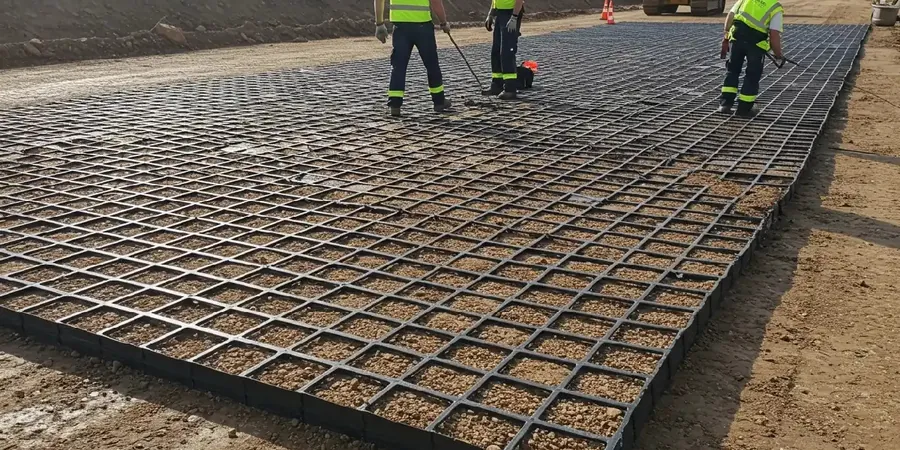
Working in Bendigo, we see a lot of variability in subgrade conditions. The old goldfields left behind a mixed legacy of deep alluvial clays, colluvial sands, and areas of made ground from historical mining. A proper geogrid specification isn't just about picking a tensile strength off a datasheet. It's about matching the grid aperture to the local soil's particle size distribution and the design traffic loads. We've seen too many projects where a standard grid was specified without checking the subgrade CBR, leading to rutting within months. Before you finalize a geogrid spec, it pays to correlate the design with a CBR test to confirm the subgrade support category.
Getting the geogrid aperture wrong in Bendigo's goldfield clays can turn a 50-year pavement into a 5-year problem.
Method and coverage
A geogrid specification for Bendigo must differentiate between the stiff clays around the CBD and the looser sandy fills found in the newer estates like Epsom or Strathfieldsaye. For a road pavement on a CBR 2% clay subgrade, a biaxial geogrid with a minimum ultimate tensile strength of 30 kN/m and a junction efficiency above 90% is typical. In contrast, working platforms on the low-lying areas near Bendigo Creek often require a triaxial grid to handle multidirectional stresses. We always pair the geogrid design with a plate load test to verify the modulus of subgrade reaction before full-scale placement. The key parameters we specify include the grid aperture size, tensile strength at 2% and 5% strain, and the creep reduction factor for long-term performance.
Technical reference image — Bendigo
Regional considerations
AS 4678:2002 is the governing standard for earth-retaining structures in Australia, and it has a specific annex on reinforced soil slopes using geogrids. In Bendigo, the biggest risk we see is specifying a grid based on tensile strength alone without accounting for the long-term creep behavior in the local clayey fill. The goldfield clays have a high plasticity index (PI often > 35), which can cause differential creep between the grid and the soil over decades. We've had to re-engineer two subdivision pavements in the past five years because the original geogrid specification ignored the interaction with the active clay profile. A proper pullout resistance test on site-specific soil is non-negotiable.
25–35 mm x 25–35 mm (cohesive soils), 35–50 mm (granular)
Creep Reduction Factor (120 yr design)
0.40–0.55 (per ISO 13431)
UV Resistance (500 hr Xenon Arc)
≥ 80% retained strength (AS 1289)
Complementary services
01
Geogrid Design Verification
We review your proposed geogrid specification against the site-specific soil data from your geotechnical investigation. This includes confirming the grid's index properties (aperture, tensile strength at 2%/5% strain) align with the subgrade CBR and the design traffic loading. We issue a compliance statement for AS 4678.
02
Pullout Resistance Testing
Using a large-scale pullout box, we test the selected geogrid in the actual Bendigo soil placed at target density and moisture. This gives you the true interface shear parameters (δ, cᵢ) for your slope stability or pavement design. We report results in accordance with AS 1289.
Standards that apply
AS 4678:2002 — Earth-retaining structures (Annex D: Reinforced soil), AS 1726:2017 — Geotechnical site investigations (soil classification for grid-soil interaction), AS 4133.4.2 — Determining tensile properties of geogrids by the multi-rib tensile method, ISO 13431:1999 — Geotextiles and geotextile-related products — Determination of tensile creep and creep rupture behaviour
Q&A
What is the typical cost range for a geogrid specification review in Bendigo?
A full design verification with pullout testing typically ranges between AU$700 and AU$1,890 depending on the number of grid types and soil samples. For a standard subdivision pavement review without pullout testing, expect to pay around AU$950.
Can I use a standard biaxial geogrid for a residential driveway on clay?
Only if the subgrade CBR is above 3%. For Bendigo's common low-plasticity clays (CBR 1–2%), a biaxial grid with at least 30 kN/m ultimate strength is needed, but you also must check the aperture size won't clog with the clay. A triaxial grid often performs better because the triangular aperture resists clogging better in cohesive soils.
How does the goldfields history affect geogrid specification?
Historical mining left pockets of loose fill and variable compaction across Bendigo. A geogrid specified for uniform subgrade may fail where old shafts or trenches exist. We recommend a minimum of one georradar survey per hectare to map any buried voids before finalizing the grid layout. This extra step has saved several projects from costly rework.
What long-term durability testing is required for geogrids in Bendigo?
Australian standards require a creep reduction factor based on 10,000-hour creep testing (ISO 13431) for design lives over 50 years. For the goldfield clays with high plasticity, we also recommend a chemical resistance test against the local acidic groundwater (pH often 4.5–5.5) to confirm the polyester or polypropylene grid won't degrade over time.