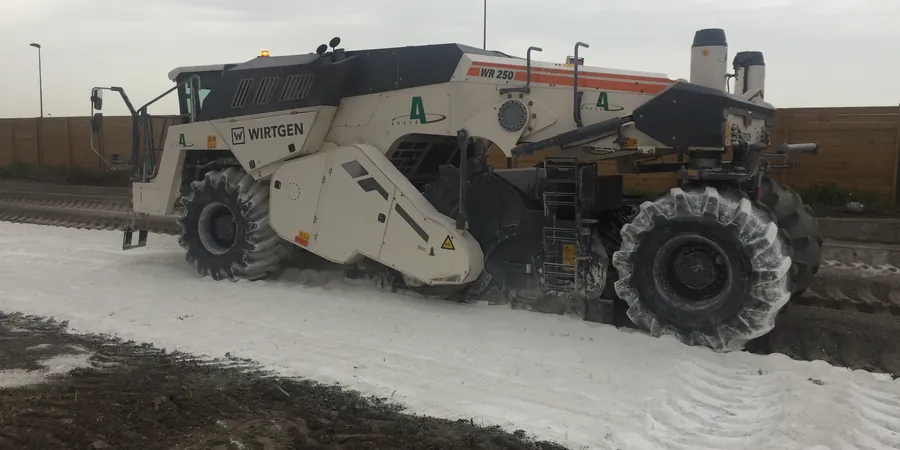
In Bendigo, road projects must contend with highly reactive clay profiles and the legacy of historical gold mining. Our approach to soil stabilization for roads in Bendigo follows AS 1726 and AS 4678, ensuring the subgrade meets design specifications. We treat the expansive soils typical of the region using controlled lime or cement addition, then verify the results through laboratory testing. Before treatment begins, a full characterization of the site is essential. We often recommend a subgrade bearing capacity study to establish baseline CBR values, and a CBR test to confirm the design strength after stabilization. This sequence prevents premature pavement failure.
Treating Bendigo's reactive clays with controlled lime addition can triple the soaked CBR, preventing pavement deformation within the first five years.
Method and coverage
Bendigo sits at roughly 220 meters above sea level, with annual rainfall around 550 mm concentrated in winter. The local soils, derived from Paleozoic sedimentary rocks and alluvial goldfield deposits, show high plasticity and variable moisture content. For effective soil stabilization for roads in Bendigo, we focus on reducing plasticity index and increasing the soaked CBR to at least 5% for subgrades. Our process involves:
Sampling at multiple depths across the proposed alignment.
Atterberg limits and Proctor compaction to determine additive dosage.
Unconfined compressive strength testing on treated specimens after 7-day curing.
Field verification using plate load testing to confirm modulus of subgrade reaction.
This methodology aligns with Austroads pavement design guidelines.
Technical reference image — Bendigo
Regional considerations
The climate in Bendigo swings from dry summers to wet winters, causing cyclic swell-shrink behavior in the soil. If soil stabilization for roads in Bendigo is not designed with this moisture variation in mind, the pavement can experience differential heave and longitudinal cracking within three to five years. Old mine shafts and shallow workings also present collapse risks under road embankments. We always recommend a geophysical survey to detect voids before stabilization work begins. The combination of reactive clays and hidden mining cavities demands thorough investigation.
Determination of optimal additive content through Eades & Grim pH test, Atterberg limits, and unconfined compressive strength on treated samples.
02
Moisture-Density Relationship (Modified Proctor)
Modified Proctor compaction (AS 1289.5.2.1) to establish target density and optimum moisture content for stabilized layers.
03
Soaked CBR Testing
California Bearing Ratio test after 4-day soaking to simulate worst-case field moisture conditions and verify design strength.
04
Field Density and Compaction Control
Nuclear gauge or sand replacement method (AS 1289.5.8.1) to confirm in-situ compaction meets specification after stabilization.
Standards that apply
AS 1726 – Geotechnical site investigations, AS 4678 – Earth retaining structures, Austroads Guide to Pavement Technology Part 4D (2021), AS 1289.3.1.1 – Atterberg limits
Q&A
Why is soil stabilization for roads in Bendigo different from other cities?
Bendigo has highly reactive clay soils derived from weathered Ordovician sedimentary rocks, plus the added complication of historical underground gold mining. These clays have a plasticity index often exceeding 35%, requiring higher lime or cement dosages than typical Victorian soils. The presence of old mine shafts also requires void detection before stabilization work.
What tests do you run to design the stabilization mix?
We start with Atterberg limits and particle size distribution to classify the soil. Then we run the Eades & Grim pH test for lime modification, followed by unconfined compressive strength tests on specimens cured for 7 days. A soaked CBR test confirms the final design. All testing follows AS 1289 and is performed in our NATA-accredited lab.
How much does soil stabilization for roads in Bendigo cost?
For a typical road stabilization project in Bendigo, costs range between AU$1,200 and AU$5,280 depending on the number of samples, additive dosage trials, and field verification required. This covers laboratory mix design, compaction control, and final CBR validation. Larger volumes benefit from economies of scale.
How long does the stabilization testing process take?
The full process from sampling to final report takes 10 to 14 working days. The 7-day curing period for UCS specimens is the critical path. We can expedite this if you need preliminary dosage recommendations within 5 days, but final strength results require the full curing time.