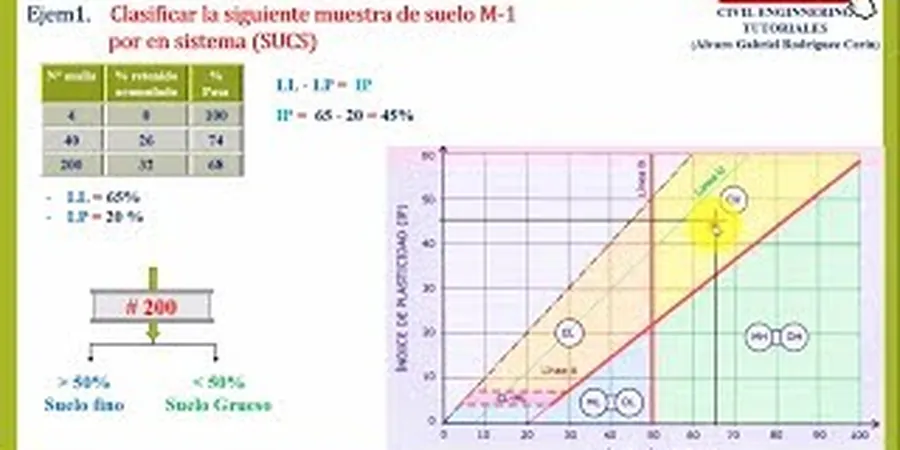
For any geotechnical investigation in Bendigo, soil classification under the Unified Soil Classification System (USCS) and AASHTO M 145 is the foundational step, directly following AS 1726:2017 for site investigation. The city's geology — dominated by Quaternary alluvium in the Bendigo Creek valley and Ordovician sedimentary rocks on the hills — produces highly variable soil profiles where a single building lot can transition from stiff clay to loose sand within a few meters. Proper classification using sieve analysis, hydrometer, and Atterberg limits separates cohesive from granular materials, which dictates everything from bearing capacity assumptions to compaction targets. When profiles show high-plasticity clays, a concurrent permeability field test helps assess drainage for any proposed excavation or subgrade preparation.
In Bendigo's mixed geology, USCS group symbols change within 50 meters horizontally — one sample as CH, the next as SM.
Method and coverage
Bendigo's soil variability means that classification results from the northern suburbs, such as Epsom with its well-drained sandy loams over gravel, often contrast sharply with the heavy black clays found in Long Gully. We process each sample through a consistent workflow: air-drying, sieving through 75 mm to 0.075 mm meshes, and plotting cumulative curves. For fine-grained soils, the Casagrande cup and rolling-thread tests determine liquid and plastic limits, respectively. The plasticity chart then places the material as CL, CH, ML, or MH. AASHTO classification follows, using the group index calculation. This dual-system approach gives both the civil engineer and the structural designer complementary datasets. When the classification reveals expansive clay, we recommend pairing it with an Atterberg limits test to quantify shrink-swell potential before foundation design proceeds.
Technical reference image — Bendigo
Regional considerations
In Bendigo's older residential areas like Golden Square and Kangaroo Flat, we frequently encounter fill placed over the original gold-mining era that was never compacted or classified. Building on undocumented fill without a soil classification creates a hidden risk: the material may behave as a loose silt (ML) with collapse potential when wetted, or as a clayey sand (SC) with moderate bearing capacity but high frost susceptibility. Classification identifies these materials before a slab is poured, allowing the engineer to specify removal, deep footing, or Improvement accordingly. Without it, differential settlement becomes almost certain within the first two seasonal cycles.
USCS Classification by Visual-Manual and Laboratory Methods
Complete identification of coarse-grained and fine-grained soils using AS 1726 visual-manual procedures followed by laboratory verification with sieve analysis (AS 1289.3.6.1), hydrometer (AS 1289), and Atterberg limits (AS 1289.3.1.1). Results include group symbol, group name, and particle-size distribution curve.
02
AASHTO M 145 Classification for Pavement and Subgrade Design
Tailored for road and pavement projects in Bendigo, this service classifies soils into A-1 through A-7 groups based on particle size, liquid limit, and plasticity index. It directly informs subgrade rating for flexible pavement design per Austroads guidelines and AS 4678 earth-retaining structures.
This service complements our laboratory testing work for a complete project analysis.
Standards that apply
AS 1726:2017 — Geotechnical site investigations, AS 1726 — Standard Practice for Classification of Soils for Engineering Purposes (USCS), AASHTO M 145-91 (2021) — Classification of Soils and Soil-Aggregate Mixtures, AS 1289.3.6.1 — Determination of particle size distribution (sieving and hydrometer)
Q&A
Why do I need both USCS and AASHTO classification for a Bendigo project?
USCS (per AS 1726) focuses on engineering behavior — compressibility, strength, and drainage — making it essential for foundation and retaining wall design in Bendigo's variable soils. AASHTO M 145 groups soils by their performance as highway subgrade, using the Group Index to rate load-bearing capacity. Combined, they give the design team both structural and pavement data from a single sample set.
How does soil classification affect foundation design in Bendigo's clay areas?
Clay soils classified as CH (high plasticity) under USCS indicate high shrink-swell potential, which directly influences footing depth and slab reinforcement. In Bendigo, reactive clays often require stiffened raft slabs or bored piers extending below the active zone. Classification also feeds into the site classification per AS 2870 for residential slabs and footings.
What is the cost range for a full USCS/AASHTO soil classification in Bendigo?
The typical cost for a complete classification package — including sieve analysis, hydrometer, Atterberg limits, and dual system reporting — ranges between AU$110 and AU$180 per sample. Volume discounts apply for multi-bore projects, and the exact price depends on the number of tests required and any additional organic content analysis.
Can soil classification detect contamination from Bendigo's mining history?
Standard USCS/AASHTO classification does not test for chemical contaminants such as arsenic, mercury, or cyanide residues common in Bendigo's historical mining areas. However, visual classification per AS 1726 may flag unusual colors, odors, or staining. If contamination is suspected, a separate environmental soil analysis — including heavy metals and pH — should be ordered alongside the geotechnical classification.