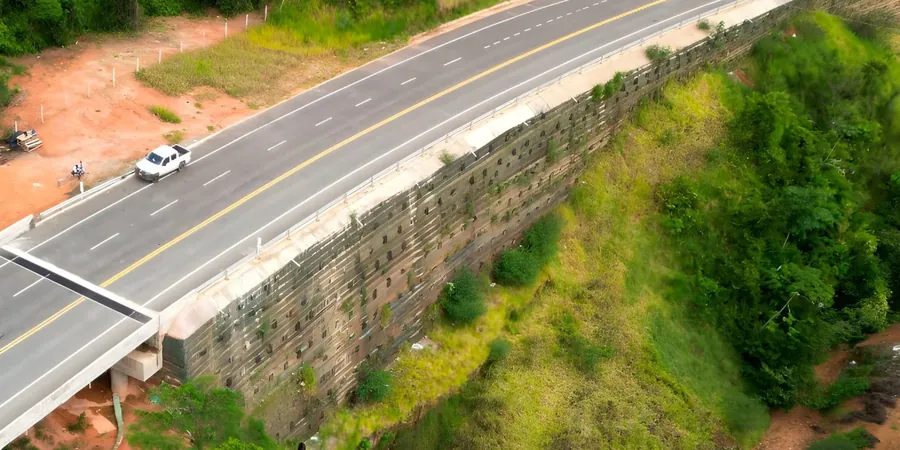
Bendigo sits on the northern slopes of the Great Dividing Range, where the landscape transitions from heavily weathered sedimentary rock to deep alluvial deposits along the Bendigo Creek corridor. This geological variability means the same MSE wall design that works on the granite-derived soils of Big Hill may struggle with the expansive clays found around Lake Weeroona. Our approach begins with a detailed site investigation that includes permeability field testing to evaluate drainage behaviour, as water buildup behind the reinforced zone is a primary cause of instability in this region. Matching the reinforcement layout and backfill selection to the actual ground conditions, rather than assuming uniform parameters, is what separates a durable design from one that requires costly retrofitting within a few seasons.
We cross-reference historic mine plans for Bendigo sites to detect old gold workings before finalising reinforcement layout.
Method and coverage
Bendigo grew rapidly during the gold rush of the 1850s, and that legacy still shapes its subsurface. Many sites contain old mining voids, loose fill from historical excavations, or unexpected bedrock at shallow depth. When we develop an MSE wall design for a project in the central business district, we always cross-reference the historic mine plans held by the Geological Survey of Victoria. If the site sits within a known reef line, we recommend a georadar survey to map any near-surface voids before finalising the wall layout. The reinforcement must be positioned to bridge over any soft spots without creating differential settlements that crack the facing panels. Our design process also accounts for the local requirement to maintain a minimum 1-metre setback from property boundaries, which often forces us to use shorter reinforcement lengths than we would prefer, requiring higher strength geogrids to compensate.
Technical reference image — Bendigo
Regional considerations
A residential subdivision near Epsom saw a 5-metre-high MSE wall tilt 80 mm over two summers because the design assumed a uniform granular backfill that was never specified in the construction tender. The contractor used on-site clayey sand with a plasticity index of 18, which swelled seasonally and reduced the pullout resistance of the geogrid layers. We were called in to retrofit a drainage blanket and install soil nails through the facing to restore stability. That project taught us that clear communication of backfill specifications during the tender phase is just as critical as the calculations themselves.
150 - 400 kPa for stiff clays and dense sands in Bendigo
Complementary services
01
Full Geotechnical Investigation for MSE Walls
This package covers boreholes, test pits, and laboratory testing to classify the on-site soils and determine the strength and stiffness parameters required for MSE wall design. We assess the foundation bearing capacity, the internal stability of the reinforced soil mass, and the external stability against sliding, overturning, and bearing failure. The final report includes reinforcement type recommendations, spacing calculations, and drainage design criteria.
02
Structural MSE Wall Design & Certification
For projects where the client already has geotechnical data, we take over the structural design phase. Using limit equilibrium methods and finite element modelling, we size the reinforcement layers, design the facing system, and verify global stability. We also provide certified design documentation suitable for building permit applications in the City of Greater Bendigo.
Standards that apply
AS 4678:2002 Earth-retaining structures, AS 1726:2017 Geotechnical site investigations, AS/NZS 1170.2:2011 Structural design actions (wind loads), FHWA-NHI-10-024 Design of Mechanically Stabilized Earth Walls
Q&A
How much does MSE wall design typically cost for a Bendigo residential project?
For a standard 3-metre-high MSE wall supporting a residential driveway or retaining fill, the geotechnical investigation and structural design together range from AU$2,000 to AU$6,610. This covers boreholes, laboratory testing, stability analysis, and certified drawings. Larger commercial walls with complex geometry or poor ground conditions will sit at the upper end of that range.
What soil conditions in Bendigo are most problematic for MSE walls?
The most challenging conditions are the expansive clays found in the northern suburbs and the loose mine tailings around the historic goldfields. Expansive clays can exert high lateral pressures when they wet up, while fill over old shafts may settle unevenly under the reinforced mass. In both cases we recommend soil improvement or deeper foundations before starting the MSE wall construction.
How long does the MSE wall design process take from site visit to final drawings?
A typical residential MSE wall design takes three to four weeks from the initial site inspection to delivery of the stamped structural drawings. This includes one week for drilling and sampling, one to two weeks for laboratory testing, and one week for analysis and drafting. Complex projects with multiple wall tiers or high groundwater can add one to two weeks.