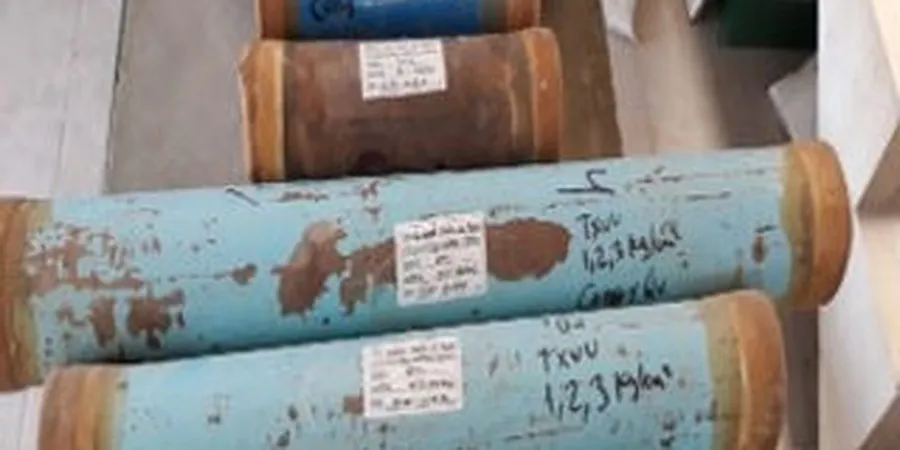
Bendigo sits on a mix of deeply weathered sedimentary rock and Quaternary alluvium from former gold-mining activity. The seasonal wet-dry cycle, with annual rainfall around 650 mm concentrated in winter, saturates the upper clay layers and then dries them hard in summer. That moisture fluctuation destroys the natural structure of soft clays and silts if you use disturbed sampling methods. We recover undisturbed samples using thin-walled Shelby tubes to preserve the in-situ fabric, density, and water content. The tube is pushed hydraulically into the base of a borehole at a controlled rate, avoiding vibration or hammering. This method is essential when the laboratory program requires reliable consolidation or triaxial strength parameters — not estimated values.
Preserving in-situ soil structure with Shelby tubes gives you design parameters that site-specific correlations simply cannot match.
Method and coverage
The eastern suburbs like Epsom and Kangaroo Flat often have collapsible alluvial soils, while central Bendigo around View Street exposes stiff residual clay over weathered sandstone. Our undisturbed sampling adapts to both. We use 75 mm diameter Shelby tubes for cohesive soils and larger 100 mm tubes when the sample contains fine gravel. The push rate is kept below 20 mm per second, and we measure recovery immediately after extraction. All tubes are sealed with wax and plastic caps, then stored in chilled containers to preserve moisture. The NATA-accredited laboratory follows AS 1289.1.1 for handling and trimming. Before final sampling, we may run a dilatometer profile to confirm soil consistency and select the best depth intervals for tube extrusion.
Technical reference image — Bendigo
Regional considerations
Bendigo expanded rapidly during the 1850s gold rush, and many residential subdivisions now sit on old diggings, tailings, or filled creek lines. Those loose, heterogeneous deposits compress unpredictably under load. If you rely on disturbed samples or SPT correlations alone, you miss the true collapse potential and consolidation rate. Undisturbed sampling in Bendigo captures the actual void ratio and cementation of these fills and residual soils. Without it, foundation designs may underestimate long-term settlement by a factor of two or more. That risk is especially high on sloping blocks where differential movement cracks slabs and walls.
Field hydraulic push of 75 mm or 100 mm tubes, wax-sealed transport, and laboratory determination of consolidation (Cc, Cv), drained/undrained triaxial strength, and Atterberg limits.
02
Borehole Logging and Sample Integration
Continuous log of soil type, moisture, and SPT N-values alongside tube recovery depths. We align all data in a single report for your geotechnical model.
Standards that apply
AS 1289.1.1 – Sampling of soils (undisturbed), AS 1726:2017 – Geotechnical site investigations, AS 1289.6.0/D1587M – Thin-walled tube sampling
Q&A
What is the difference between undisturbed and disturbed sampling?
Disturbed samples (e.g., bag samples) lose the natural fabric, density, and water content. Undisturbed Shelby tube samples preserve the in-situ structure, so laboratory tests yield true consolidation, stiffness, and strength parameters for design.
How much does undisturbed sampling with Shelby tubes cost in Bendigo?
The typical range is between AU$660 and AU$1,740 per tube, depending on depth, borehole access, and whether the tube is tested immediately or stored for later testing.
How do you avoid sample disturbance in sandy soils?
For sands, we use a fixed-piston Shelby tube with a cutting shoe angle of less than 10 degrees. The borehole is advanced with drilling mud to prevent caving, and the tube is pushed at a constant rate without rotation.