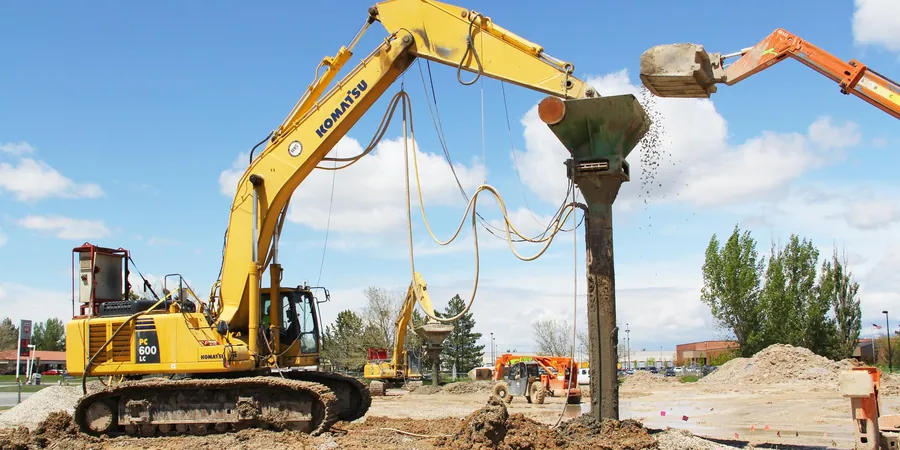
A commercial development near the Bendigo railway station required treatment of loose alluvial sands before foundation construction. The site, positioned on former gold mining tailings mixed with natural deposits, showed variable density across the footprint. We provided a complete vibrocompaction design that specified probe spacing, vibration energy levels, and compaction depth targets based on the local soil profile. Before mobilising the vibrocat, our team conducted a thorough site investigation including MASW testing to map stiffness variations across the plot. The resulting design parameters ensured the loose sands reached relative densities above 70 percent, meeting the structural engineer’s bearing capacity requirements for shallow footings.
Our vibrocompaction designs in Bendigo consistently achieve relative densities above 75 percent, verified by post-treatment CPT soundings and plate load tests.
Method and coverage
In Bendigo, we frequently encounter deep granular layers that respond well to deep vibratory densification. The local geology, shaped by ancient river systems and historic mining activity, creates pockets of variable compaction that need careful treatment. Our vibrocompaction design process begins with a detailed borehole campaign to identify the depth and extent of loose zones. We then calculate the optimum grid pattern, typically a triangular layout with spacing between 2.0 and 3.5 metres depending on grain size distribution. The team also evaluates the liquefaction potential of the treated layer using the NCEER method, and if needed, we integrate drainage geotechnics to manage pore pressure build-up during the vibratory process. Each design is calibrated against the soil’s natural moisture content and fines percentage to avoid over-vibration.
Technical reference image — Bendigo
Regional considerations
The Bendigo region sits within a zone of moderate seismicity under AS/NZS 1170.4, which means loose saturated sands pose a genuine liquefaction risk during a seismic event. Historic gold mining left behind uncompacted tailings and backfilled voids that can settle unevenly under vibration or earthquake loading. If vibrocompaction design does not account for the presence of these variable fill materials, differential settlement after construction could exceed tolerable limits for concrete slabs or road pavements. Our approach includes a site-specific seismic hazard analysis and post-treatment cone penetration testing to confirm that the densified ground meets the required cyclic resistance ratio for the design earthquake.
Detailed borehole drilling, standard penetration testing, and laboratory classification of soils to determine grain size, fines content, and in-situ density. This data forms the basis for a reliable vibrocompaction design.
02
Post-Treatment Verification Testing
After compaction, we conduct cone penetration tests (CPT), plate load tests, and seismic dilatometer tests to confirm that the densified ground meets your project specifications. Reports include density profiles and bearing capacity estimates.
How deep can vibrocompaction treat soils in Bendigo?
Typical effective depths range from 3 to 12 metres, depending on the vibratory probe power and the soil’s grain size distribution. In Bendigo’s alluvial sands, we regularly reach 8 metres with standard equipment. Deeper treatments require specialised probes or a staged approach.
What is the typical cost range for a vibrocompaction design in Bendigo?
For a medium-sized commercial site, the design and verification package generally falls between AU$2,080 and AU$7,950. This includes the site investigation, design calculations, and post-treatment testing. Actual costs vary with site area, depth of treatment, and the number of verification points required.
How long does the vibrocompaction design process take?
From the initial site investigation to delivery of the final design report, the process typically takes 3 to 5 weeks. The drilling and sampling phase occupies the first week, followed by laboratory testing and numerical modelling. We coordinate closely with your structural engineer to ensure the design fits the project schedule.