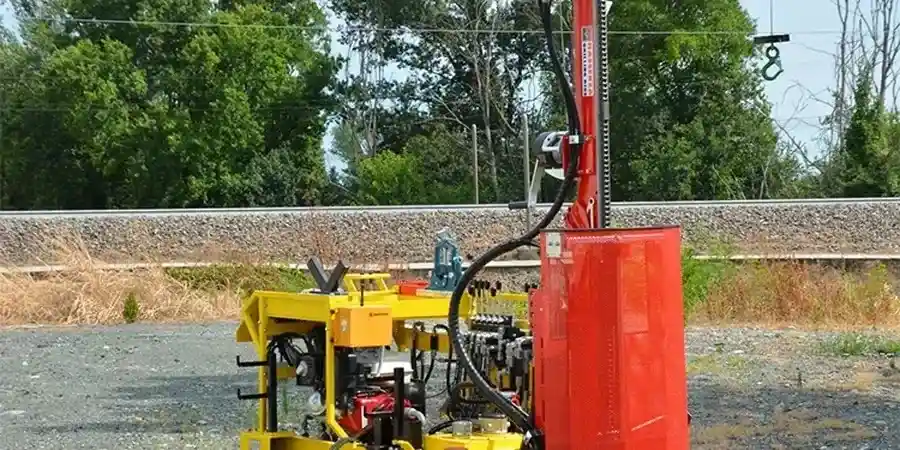
A common mistake we see on Bendigo projects: builders assume the stiff clay near the surface will hold up a footing, so they skip the borings. Then the excavator hits a layer of loose sand or old creek gravel at 3 metres, and suddenly you are redesigning the foundation mid-job. That cost blows out fast. An SPT (Standard Penetration Test) during the investigation phase gives you the N-values you need to confirm or adjust your design assumptions before concrete is poured. For sites close to the Bendigo Creek corridor or the old goldfields, the soil profile can change abruptly, and a few boreholes with continuous SPT sampling catch those transitions. We combine the blow counts with laboratory classification to build a reliable ground model, and we always reference AS 1726 for the sampling procedure. Pairing the SPT with a study of soil mechanics on the same samples gives you both strength and index properties from one investigation.
A single SPT borehole at the right location can save tens of thousands in unexpected foundation costs, but only if the N-values are corrected for hammer energy and rod length.
Method and coverage
We use a standard 63.5 kg drop hammer with an automatic trip mechanism to ensure consistent energy delivery. The split-spoon sampler is 50 mm outside diameter, and we record blow counts every 150 mm over a 450 mm drive interval. The N-value is the sum of blows for the last 300 mm. In Bendigo’s variable geology, from the Box Gully alluvium to the fractured bedrock of the Hill End Goldfield, the SPT responds differently to each material. We log the soil type and moisture state at each test depth, and we store the recovered sample in sealed jars for later verification. The procedure follows AS 1289.6.3.1 and AS 1726, and we record the hammer energy efficiency to correct raw N-values when needed. For shallow foundations, we often run a plate load test in parallel to calibrate the SPT-based bearing capacity against a direct settlement measurement. Our field crew has worked on subdivisions in Epsom, commercial sites in the CBD, and rural access roads around Maiden Gully, so we know how the local ground behaves under the hammer.
Technical reference image — Bendigo
Regional considerations
Bendigo sits in a region where the water table fluctuates seasonally by several metres, especially after the wet winter months. If you run SPT during a dry summer, the N-values in the upper clay may read higher than they will under a winter water table, leading to an unconservative design. The risk is that the bearing capacity looks fine in January, but by August the clay softens and you get differential settlement. We schedule SPT campaigns with awareness of the seasonal water level, and we always record the depth of groundwater at the time of testing. On sites near the Bendigo Racecourse or along the White Hills floodplain, we also run a field permeability test in the same borehole to quantify how the water table will respond to excavation or drainage. That combination of SPT and in-situ permeability gives you a complete picture for both strength and groundwater control design.
Full-depth SPT at 1.5 m intervals with split-spoon samples retained for moisture content, classification, and Atterberg limits. This gives you both N-values and soil type confirmation from the same borehole.
02
Energy Correction (ERi) Measurement
We instrument the drill rod string with a strain gauge and accelerometer to measure actual hammer energy transfer. Corrected N60 or N1,60 values are reported, essential for liquefaction analysis using the Youd-Idriss method.
03
SPT for Liquefaction Assessment
For sites in Bendigo’s alluvial plains where loose saturated sands exist, we run SPT at close spacing and apply the NCEER (1996) and Youd-Idriss (2001) procedures to calculate cyclic resistance ratio. The result is a factor of safety against liquefaction per depth.
04
Integrated SPT and Laboratory Testing
We coordinate the SPT fieldwork with our NATA-accredited lab for direct shear, triaxial, and consolidation tests on undisturbed samples taken adjacent to the SPT borehole. This provides design parameters validated by both field and lab methods.
Standards that apply
AS 1726 – Geotechnical site investigations, AS 1289.6.3.1 – Standard test method for SPT, AS 4678 – Earth-retaining structures, AS/NZS 1170 – Structural design actions
Q&A
What is the difference between N-value and corrected N60 in SPT?
The raw N-value is the blow count recorded in the field with whatever hammer energy the rig delivers. Corrected N60 adjusts that value to a reference energy ratio of 60%, which is the international standard for design correlations. If your rig delivers only 50% energy, the raw N might be 10 but the N60 could be 8. For liquefaction assessment or bearing capacity calculations using published correlations, you must use the corrected N60 or N1,60 (corrected for overburden pressure). We always report both raw and corrected values.
How does the SPT perform in Bendigo's goldfield bedrock?
In the fractured quartz and metasediment of the Hill End Goldfield, the SPT hammer often refuses after a few centimetres. That refusal itself is useful data: it tells you that the bedrock surface is shallow and that the N-value exceeds 50. We switch to a rock coring barrel (HQ or NQ) once SPT refusal is reached, and we log the core recovery and RQD. The combination of SPT refusal depth and rock core quality gives you the founding level for deep footings or rock-socketed piles.
How much does an SPT investigation cost in Bendigo?
A typical SPT borehole with continuous sampling to 10 metres depth, including energy correction and basic soil classification, ranges between AU$800 and AU$1,280 per borehole depending on access, number of tests, and whether you need after-hours traffic management for city sites. The price includes the field crew, hammer calibration, and a certified report with N-values and soil logs. For multiple boreholes on the same site, the per-hole rate drops.