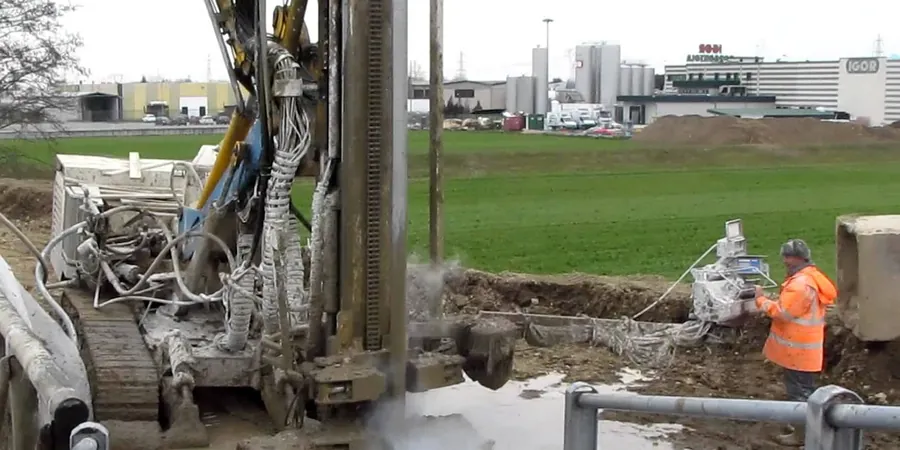
A common mistake contractors make in Bendigo is assuming that grouting is a single-approach technique. The region's soil profile shifts dramatically between the granitic residuals of the northern ridges and the alluvial clays along Bendigo Creek. A grouting design that works in one borehole can fail completely fifty metres away. Without a site-specific injection plan, you risk channeling through preferential flow paths or fracturing the ground instead of permeating it. That is why we always begin with a detailed permeability assessment before writing any grout mix. The permeability field test gives us the local hydraulic conductivity, which directly dictates whether a particulate or chemical grout is appropriate for the voids encountered.
A grouting design calibrated to Bendigo's variable geology prevents costly rework and ensures the grout curtain performs as modelled under service loads.
Method and coverage
Comparing two sectors of Bendigo makes the soil variability clear. In the Epsom area, the subsurface is dominated by stiff Quaternary clays with occasional sand lenses. Over in Golden Square, you often hit fractured bedrock from historic reef mining. A grouting design for Epsom must address fine-fissure sealing using low-viscosity chemical grouts, whereas Golden Square typically needs high-mobility cement-based injections to fill open rock joints. We cross-check these assumptions with MASW testing to map stiffness contrasts and locate potential void zones. The approach is iterative: adjust the grout rheology, verify via field trials, and refine the injection pressure limits. Every recipe is benchmarked against AS 1726 and the relevant ASTM standards for groutability.
Technical reference image — Bendigo
Regional considerations
Bendigo's urban development expanded rapidly during the 1850s gold rush, leaving behind a legacy of shallow underground workings and unrecorded stopes. Many of these voids remain unmapped beneath modern subdivisions and commercial zones. A grouting design that ignores this historical context can trigger sudden ground loss during injection or, worse, fail to seal a cavity that later collapses under traffic loading. We integrate historic mine plans with geophysical surveys to identify these hazards before the first injection point is drilled. The result is a targeted injection programme that reduces the probability of a sinkhole forming years after construction.
Cementitious (w/c 0.5–0.8) / Chemical (sodium silicate, acrylate)
Injection Pressure
50 kPa – 1.5 MPa (dependent on overburden and fracture aperture)
Water:Cement Ratio (Cement Grout)
0.5:1 to 0.8:1 by weight
Gel Time (Chemical Grout)
20 seconds – 30 minutes adjustable
Maximum Aggregate Size (if added)
< 1 mm for permeation grouting
Bleeding Limit (AS 1289)
< 2% after 2 hours for stability
Complementary services
01
Permeation Grouting Design
Low-pressure injection of particulate or chemical grouts into soil pores. Ideal for alluvial clays and sand lenses in the Epsom and Strathdale areas. We specify grout rheology to match the soil's coefficient of permeability, ensuring uniform penetration without hydrofracture.
02
Void and Fissure Grouting Design
High-mobility cementitious grouts for sealing open rock joints, old mine workings, and solution cavities. Each injection pattern is designed using the spacing-to-radius ratio derived from field packer tests. Suitable for Golden Square and other bedrock-affected zones in Bendigo.
03
Compensation (Compaction) Grouting Design
Designed for ground heave control and settlement mitigation in loose fills or collapsible soils. We calculate the grout take volume per stage, monitor injection pressure, and correlate surface heave with subsurface densification using real-time instrumentation.
Standards that apply
AS 1726 – Geotechnical Site Investigations (ground condition classification), AS 4678 – Earth-Retaining Structures (grouted anchors and tiebacks), AS 1289.6.7.3 – Standard Practice for Design and Installation of Groundwater Monitoring Wells (grout seal specifications), ASCE Grouting Committee Guidelines – Permeation and compensation grouting
Q&A
What is the difference between permeation grouting and compaction grouting in Bendigo soils?
Permeation grouting fills the pore space between soil particles without displacing the matrix, which works well in Bendigo's sandy alluvium where the void ratio is consistent. Compaction grouting uses a stiff, low-mobility mortar that displaces and densifies the surrounding soil, making it appropriate for loose fills or collapsible materials found near historic mining areas. The choice depends entirely on the soil's relative density and grain-size distribution.
How do you select the grout mix for a Bendigo site with unknown void dimensions?
We first perform a field permeability test and, if possible, a borehole camera survey to estimate void aperture. For fissures wider than 0.5 mm, a neat cement grout with a water-cement ratio of 0.6 to 0.8 is common. For narrower fractures or sandy soils, a sodium silicate or acrylate chemical grout is selected. The mix is validated through a pre-injection trial at a representative location.
What is the typical cost range for a grouting design study in Bendigo?
The cost for a full grouting design study including site visit, permeability testing, mix design, and injection plan typically falls between AU$1,900 and AU$5,890. This range covers a single injection zone up to about 5 metres depth; deeper or multiple zones will increase the scope and cost accordingly.
Can grouting be used to stabilise old mine voids under existing buildings in Bendigo?
Yes, but it requires careful pressure control and void mapping. We use a combination of low-pressure permeation to fill the void and high-mobility cement grout for the surrounding fractured rock. Real-time pressure monitoring and tilt sensors on the structure are essential to avoid heave. The approach is effective for the shallow stopes common beneath Bendigo's older commercial districts.