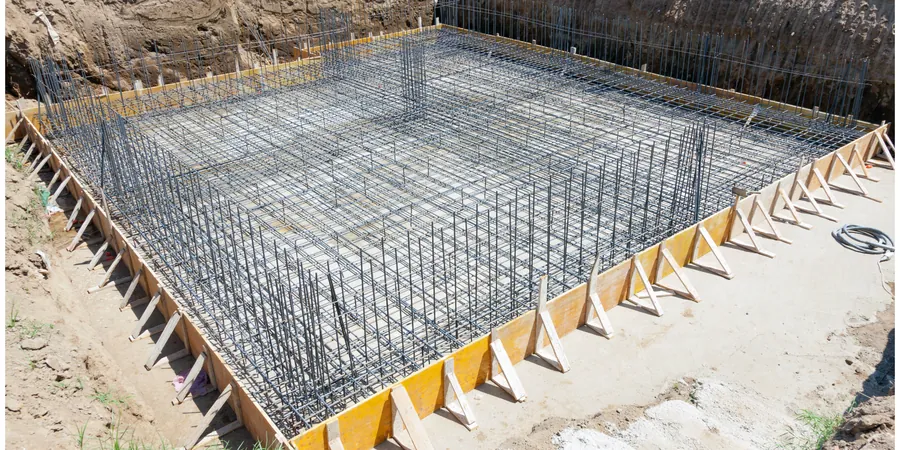
Bendigo's climate swings from hot summers to cool, wet winters. That cycle drives significant soil volume change in the region's expansive clays. A raft foundation must resist both differential heave and shrinkage without cracking. We design stiffened rafts using soil reactivity classes from AS 2870. The depth of the active zone here often reaches 2.5 m. Getting the footing detail wrong means cracked walls and slab settlement inside three years. That is why we pair each raft design with a study of soil classification to confirm the site's reactivity profile before pouring concrete. For sites with variable fill layers, we also run plate load tests to verify subgrade modulus directly.
In Bendigo's reactive clays, ignoring the active zone depth turns a raft slab into a cracked liability within three years.
Method and coverage
Most Bendigo residential sites fall into classes M to H2 under AS 2870. That means moderate to high reactivity. The design process starts with a site investigation to measure characteristic surface movement (ys). We then compute the stiffening beam layout and slab thickness. Key parameters include the subgrade reaction modulus (k-value) and the depth of the active zone. We combine field observations with lab data from Atterberg limits to confirm plasticity index and shrink-swell behaviour. Where the water table is shallow we incorporate a drainage layer to prevent long-term moisture build-up under the slab. The table below shows typical design values we use for raft foundations in Bendigo.
Technical reference image — Bendigo
Regional considerations
In Bendigo, the biggest risk is building on a site class H2 without enough beam stiffness. We see it often. The slab curls at the edges and cracks radiate from internal piers. Another common issue is leaving fill uncompacted before pouring. A 500 mm layer of loose fill can settle 30 mm under its own weight. That differential movement pulls the raft apart. We always check fill depth and compaction records. For sites with deep fill we recommend removing or pre-loading it before raft construction. A georadar survey can quickly map buried fill pockets before you finalise the foundation layout.
Complete structural-geotechnical design for stiffened rafts on reactive sites. Includes soil classification, ys calculation, beam layout, reinforcement detailing, and slab thickness. Suitable for single dwellings, townhouses, and light commercial slabs.
02
Geotechnical Investigation for Rafts
Site investigation tailored to raft design: test pits, boreholes, sampling, Atterberg limits, shrink-swell tests, and determination of subgrade modulus. Delivers a report with reactivity class, active zone depth, and design parameters.
This service complements our laboratory testing work for a complete project analysis.
Standards that apply
AS 2870-2011: Residential Slabs and Footings, AS 3600-2018: Concrete Structures, AS 1726-2017: Geotechnical Site Investigations
Q&A
What are the signs that a raft foundation is failing in Bendigo clays?
Look for diagonal cracks from corners of doors and windows, slab edges that lift or drop more than 15 mm, and sticking doors. These indicate differential movement beyond what the raft was designed to handle. Early investigation can confirm if the soil reactivity class was underestimated.
How long does a raft foundation last on reactive soil in Bendigo?
A properly designed and constructed raft on class M to H2 soil should last 50 years or more. Key factors are correct soil classification, adequate beam stiffness, and controlled moisture conditions under the slab. Annual maintenance of drainage and garden watering helps extend service life.
How much does a raft foundation design cost in Bendigo?
For a standard residential raft, design fees including geotechnical investigation range from AU$1.840 to AU$5.980 depending on site complexity and report detail. This covers soil testing, reactivity classification, structural design, and certification.